

The Story
“When Japanese people are going to a gathering, why do they ask each other what to wear tomorrow?”
An American acquaintance once asked me that, years ago.
Her friends did the same, she said — but only to make sure they wouldn’t wear the same thing.
“Isn’t it awful, wearing the same clothes as someone else?” she asked.
She had lived in Japan for about five years, following her husband’s work assignment.
By the time she returned home, she said she somewhat understood the reason —
but she never quite felt it for herself.
It wasn’t just about clothes. This “being like everyone else” showed up everywhere, I think.
Explaining it would mean talking about culture, about education — so I never went into detail with her.
Being told by a teacher that something was “not right” felt terrifying.
I wasn’t the kind of person who could shrug it off, either.
At the small school in the countryside where I grew up, being “not right” wasn’t really allowed.
Writing this, it might sound like I’m criticizing Japanese people in general —
but I was drawn to that same pressure to conform, too. At least a little.
I became “out of the standard” — too tall, that is — starting in junior high.
Through elementary school, I fit comfortably within that Shōwa-era mold of “everyone the same.”
So when I suddenly found myself pushed outside of it, it felt almost forced.
Back then, being “just like everyone else” felt like safety.
Looking back now, in an age where information flows freely and individuality is valued,
it seems like such a strange standard. Maybe it wasn’t the era — maybe it was the place.
My memory of that small place has grown hazy.
But if I went back there today, I wonder if that same “safety” would still be waiting, in some form.
Living life pushing forward, forward — sometimes, I find myself longing
for that old, familiar sense of safety.
I imagine my friend in America would understand even less, now.
Visual Story Details
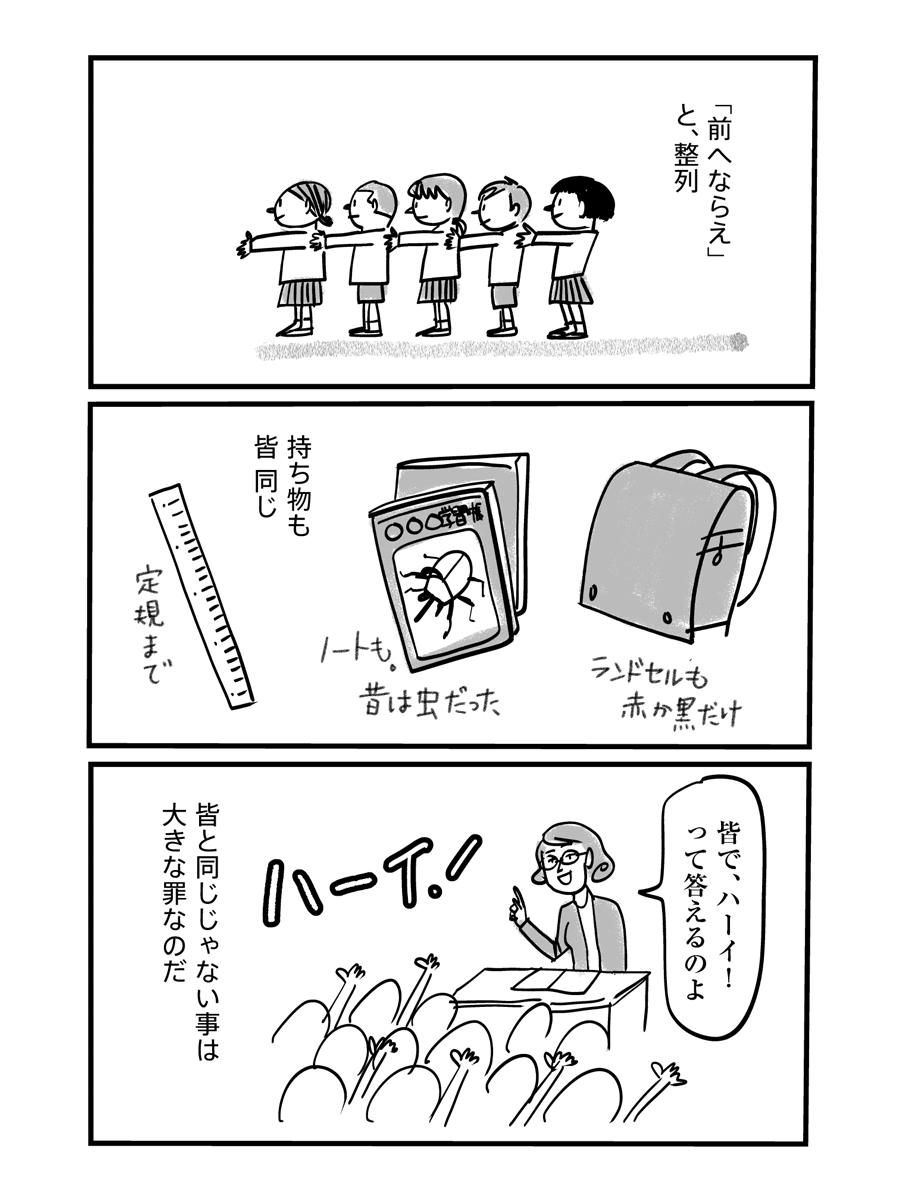
Subject:Children lining up in formation, identical school supplies in red or black, a classroom raising hands together in unison.
Mood:A complex, lyrical tone where nostalgia and quiet suffocation coexist.
Theme:The coexistence of fear and longing within conformity — the safety once found in being like everyone else.
Artist:Kazue Shima (Visual Story Artist)